Showing posts with label Temples and sights. Show all posts

Friday, 27 October 2017

.....and in conclusion

We've been back a few days now, and India still dominates our thoughts!  An incredible variety of sights and experiences, a number of mixed feelings, and no doubt done in far too little time, but on the other hand, a lifetime probably wouldn't be enough to do the whole country justice.   Our short trip will have to suffice for us.   However, I do propose to re-read Holy Cow. 

My sleeping patterns are still disrupted, far more than I would have expected a 5½ hour change to cause.  Moreover, it was only after I'd been back for a day or so that the effects started to manifest themselves.  I think there's an age factor in play here.

I'm also conscious that a number of my posts glossed over some of the sights that we saw.    Originally, I thought I might go back over some of the posts (done "on the run") and expand on them, but I'm not sure that this would really be productive.

There's one exception.   In my earlier blog post, I didn't do justice to the Jantar Mantar at Jaipur.   As I said then, this is a historic observatory at Jaipur, with large astronomical instruments.     I see from Wikipedia that it's a collection of nineteen architectural astronomical instruments, built by the Rajput king Sawai Jai Singh II (who laid out the city of Jaipur), begun in 1727 and completed in 1734. It features the world's largest stone sundial, and is a UNESCO World Heritage site.  There were five Jantar Mantar monuments in India;  others are at Delhi, which dates from 1724, Varanasi and Ujjain.  The fifth, the Muttra observatory, is gone.

We had a local guide take us around, and I'm sure his technical explanations were good.  At first, the observatory seems to be just a curious collection of sculptures, but each construction has a specific purpose such as telling the time and measuring the positions of stars and planets, altitudes and calculating eclipses.    I fear that most of what the guide told us was rather lost on our group! Just the same, the fact that so much detailed technical knowledge existed in those days was amazing in itself.

I won't attempt to describe the function of each instrument shown in the images below!


So, that's it for this blog.   I'm going to give blogging a rest for a little while, but I anticipate resuming my day-to-day blog (or a successor?) shortly.

Saturday, 21 October 2017

Jaipur

Jaipiur as a city was somewhat of a disappointment.     Yes, the hotel is lovely (the best yet, but located a distance from the centre), and the Divali dinner last night was great, but I expected more from the old town, described as the "Pink city".   In fact, it's all rather shabby.    We drove past the Hawa Mahal (Palace of the Winds), and continued to the Amber Fort (named after its location, not its colour).   This involves a jeep ride for the climb up the hill;  an interesting experience.  The Fort is, as we've now come to expect, a series of chambers and courtyards, and quite impressive in its own way.

This was followed by a "shopping opportunity" (featuring semi-precious stones, for which Jaipur is traditionally noted), lunch and then a visit to Jantar Mantar, a historic observatory  and the City Palace.   The observatory was fascinating.  A guide explained how each of the large instruments was intended to operate, but since I'm not an astronomer, I couldn't really follow the details.

Dinner in the evening was at Ikaki Niwas, a B&B operated by a Rajasthani family. It's operated by a husband and wife couple, and as is typical, the house (a large one) is owned by the husband's parents, who also live there.  The husband spent some time working for a large US company and both he and his wife speak excellent English, yet the family arrangements are still very traditional.   We were briefly introduced to the mother.   Dinner was preceded by a cooking demonstration, mainly conducted by Devika (but the husband took over briefly when she went to settle the 3 month old baby!)   At dinner I sat next to Devika (the wife), and the interesting discussion around the table covered matters such as arranged marriages (as hers was), big weddings, family life, the prevalence of mobile phones in India (even amongst those who at first sight might be thought to have other prior calls on their means) and more.

Palace of the Winds

Gateway, Amber Fort

Decorative detail

One of the courtyards

View into chambers

Looking out from Fort

Elephants to take tourists up and down (optional!)

Observatory instrument

Part of City Palace

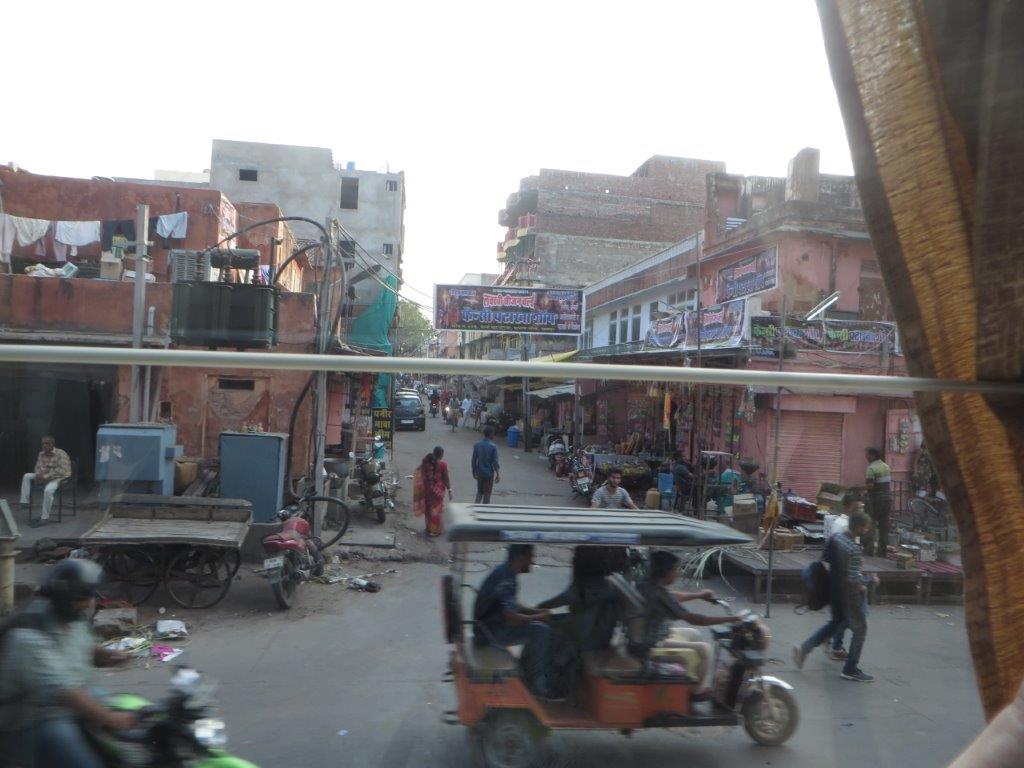
Shabbiness, Jaipur
.

Friday, 20 October 2017

Agra to Jaipur

It was Diwali, and we had a long and very full day travelling from Agra to Jaipur across the flatness of Rajasthan.   So much to fit in!   I can't do it justice in this post, so may have to come back later with more details.   We explored the deserted (but very well preserved) palace of Fatehpur Sikri (occupied only for 14 years by Emperor Akbar), had lunch at the Raj's palace at Bharatpur (now as luxury hotel), inspected the Chand Baori Stepwell at Abhaneri before arriving in Jaipur to a lavish Diwali Festival dinner.
Bus decorated for Diwali

One of several courtyards at Fatehpur Sikri

Detail in the stonework

Stepwell

Welcome to Dewali dinner!

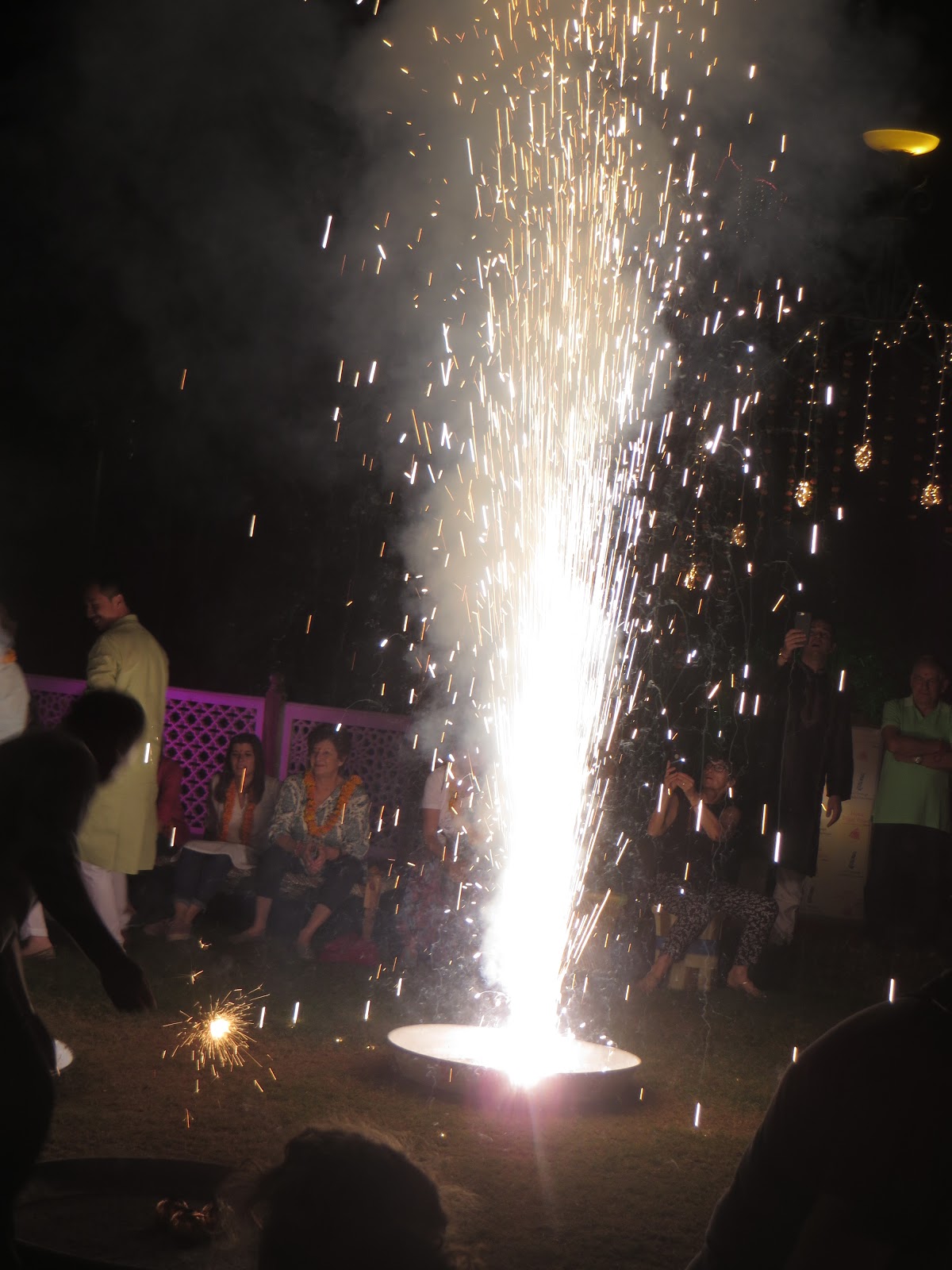
Fireworks for Diwali, and then more fireworks!

Agra Fort

Our early morning visit to the Taj Mahal was followed by a civilised breakfast, then the obligatory tour of a "marble inlay workshop" complete with an excessive amount of time while captive to allow for "shopping".   This was expensive even by Australian standards, but these interludes are part of the deal when signing up for a tour, and a number of our co-travellers appear to revel in every "shopping opportunity" that comes along.   Oh well.

We then headed to Agra Fort.    This is indeed an imposing structure. Much of it was build by Emperor Akbar (whose tomb we visited the previous day).   It's largely built from red sandstone and includes an enormous array of courtly buildings, rooms and courtyards, representing a whole range of styles.

From the higher parts of the structure, you look out over the Yamuna Rover and can see the Taj Mahal in the middle distance.    By the time the tour finished, we were ready for a pleasant buffet lunch before declining the opportunity of an auto-rickshaw tour. Instead we rested up for dinner which was in the hotel.

The following day we headed to Jaipur.   A long day, and it was Diwali, so more to come on this (when I get a few spare moments!)


. 

Wednesday, 18 October 2017

The Taj Mahal

Well, that's why you visit Agra, isn't it?    In fact, it's why you come to India - to see the Taj Mahal?  Well, actually no, because there are lots of monuments as well as other sights.    But, at 6 am, we were lining up ready for when the gates opened.   And yes, the Taj Mahal is magnificent with a little early morning river mist, and to see the changing colours as the sun rises is impressive.

You could indeed sit there and contemplate its beauty and appreciate the effort and workmanship that went into its construction.


For a few moments you might even forget about the photographers prowling around, whose intrusiveness fades into nothing by comparison with the guys selling a wide range of trinkets back at the car park - the most persistent we've yet encountered (and that's saying a lot!).   And there was hardly any queue for entry at 8 am, when we left.


To Agra

The road from Delhi to Agra is mostly a tolled expressway so we moved along quite nicely.    However, by the time we had a morning tea stop then lunch before checking in, it was mid-afternoon before we were established in our (very nice) accommodation.    It wasn't long before we were off to the 3rd Mughal (Akbar) emperor's tomb at Sikandra, 4 km northwest of Agra (and reached by means of congested local roads).

The tomb complex includes over 100 acres of well-maintained gardens, and includes a large entrance building as well as the mausoleum complex itself.

I could add more, but we need to have an early night because we're up early in the morning to see the Taj Mahal.
Entrance gate complex


Mausoleum


Mausoleum

Tomb

Street scene, Agra

Monday, 16 October 2017

The Sights of Delhi

Our itinerary described the activity for today as "a full day of sightseeing around Old and New Delhi", and supposedly included a drive past the Red Fort (well, we saw it from some distance away, with no opportunity for a photo!), a walk through the "fascinating Chandri Chowk Bazaar" (which turned out to be a fascinating - but nerve-wracking- pedi-cab ride!), a visit to Jama Majid (the biggest mosque in Delhi, or even in the whole of India?   And cameras permitted only on payment of a fee), visits to the Narayan Hindu Temple (interesting, but no cameras at all permitted) and to Humuayn's Tomb (highlight of the day), plus views of India Gate, Parliament House and various government buildings.

What wasn't stated was that although the distances between the sights isn't great, the day did involve lots of time negotiating Delhi's traffic as well as time out for lunch (Indian food, very good).  Delhi is split into Old Delhi and New Delhi, and the traffic in the narrow streets and lanes of Old Delhi as well as on the wider, tree-lined boulevards of New Delhi is all horrendous!    And the road network (all over) is complex;  I tried to follow our progress on the map, but for much of the time couldn't do so.

As I've said, Humayun's Tomb was definitely the highlight for me.  This is said to be a landmark of Mughal architecture, having been built in 1570 for the Mugul Emperor Humayun.   It was commissioned by his wife, and was the first garden tomb in India.
Lakshmi Narayan Hindu Temple

India's famous discriminatory admission charges!

Approach to Humayun's Tomb

Humayun's Tomb (I assume)

Humayun's Tomb, exterior

....the traffic!

India Gate (monument to Indians who died in WW1)